
Most people think a self-defense situation starts when the threat presents itself. It doesn’t. By the time a weapon comes out, the fight is already decided. You’re either ahead or you’re dead.
This is the reality that cops, security professionals, and armed citizens live in every single day. The bad guy is already ready. He’s already made his decision. He knows what he’s about to do. You don’t. His hand goes in his pocket and it could come out with a phone, a knife, a gun, or nothing at all. You don’t get to know until it happens. And when it happens, it happens in one to three seconds.
You cannot play catch-up in a gunfight. A person who is three seconds late is a one-second dead person.
The Rule of Threes
Decades of FBI data and independent research from people like Tom Givens and Active Self Protection paint a brutally clear picture of what civilian defensive shootings actually look like in the United States:
- 3 seconds or less in duration
- 3 rounds fired
- 3 yards (9 feet) of distance
That’s it. That’s the whole encounter. There is no time for a slow, methodical sight picture. There is no time to process what’s happening and then formulate a response. By the time your brain catches up, it’s already over. You either had the skills built into your hands and the awareness built into your mind, or you didn’t.
Engagement Range
The distance is almost always much closer than what people practice at the range:
- Roughly 90% of defensive shootings occur between 9 and 15 feet (3 to 5 yards)
- Nearly 45% happen at 0 to 5 feet — often involving physical contact before a firearm is even drawn
- Encounters beyond 15 yards are statistically rare for civilians, where retreat becomes a more viable legal and tactical option
When and Where
| Category | Typical Finding |
|---|---|
| Peak Hours | Most events occur between 6:00 PM and 6:00 AM |
| Common Days | More frequent on weekends and holidays |
| Primary Locations | 50–60% occur in or near the home |
| Public Spaces | Parking lots and gas stations are high-frequency zones |
This isn’t theory. This is what actually happens. And if this is what actually happens, then your training needs to reflect it.
So What’s the Solution?
If you’re always one step behind, the answer isn’t faster hands. It’s earlier awareness.
My method is simple. When I find myself in a situation where I know my life could be at stake, I don’t walk in hoping for the best. I go in ready. And “ready” doesn’t mean hand on my gun. It means my mind is already locked in before anything happens.
The first thing I do is ground myself. Completely. I tune out every other thought in my head — what I had for breakfast, the argument from this morning, the text I haven’t replied to — all of it goes away. I deliberately and completely anchor myself in the present moment. Nothing else exists except what is directly in front of me.
I have a physical technique that works for me: I blink three times rapidly, focus, then blink three times again and focus. I bend my knees slightly and feel the ground beneath my feet. These are grounding techniques. They force my nervous system out of autopilot and into the present. There may be others that work for you. The technique doesn’t matter. What matters is that you have one and you use it deliberately.
Once I’m grounded, something shifts. I’m able to think and see things clearly. The world around me feels like it’s moving in slow motion, but I’m still operating at my normal speed. That’s the state you want. That’s the edge. Not adrenaline. Not aggression. Clarity.
Reading the Threat Before It Becomes One
Once you’re grounded and present, the next step is reading your subject. This is where situational awareness stops being a buzzword and starts being a skill:
- Watch their hands. Hands kill. Everything else is a distraction. Where are the hands? What are they doing? Are they moving toward a pocket, a waistband, a bag?
- Read their expression. Is there fear? Anger? The flat, blank look of someone who has already committed to violence? The face tells you where the mind is.
- Scan for gun prints. Look for bulges, printing through clothing, an asymmetric hang on one side of the body, a hand that keeps drifting to the same spot.
- Watch their eyes. Are they scanning for witnesses? Looking for exits? Locked on you? The eyes telegraph intent before the body acts on it.
- Listen to their speech. Not just the words — the pace, the tone, the volume. A voice that suddenly gets calm and flat is more dangerous than one that’s yelling.
The point of all of this is not to react faster. It’s to stop reacting altogether. If you catch the indicator early enough — the shift in posture, the hand moving to the waistband, the change in their eyes — then by the time they commit to their action, you are not reacting to it. You have already hatched your own action plan. You’re not behind. You’re ahead. And ahead is where you survive.
Training the Hands to Match the Mind
Awareness gets you ahead. But awareness without execution is just watching yourself lose in high definition.
That’s why I created my own hybrid drill specifically for executive protection agents and personal protection officers who carry concealed. It pulls from the Mozambique Drill and the El Presidente Drill, but it’s built around the reality of how a concealed carrier actually has to fight when things go bad at close range with multiple threats.
Here’s how it works. The timer goes off. The EP agent or PPO draws the handgun from appendix or 3 o’clock carry. The support hand goes up to lift the garment while the firing hand establishes the master grip on the firearm. The gun comes out and points at Target 1. The first round is fired single-handed because the support hand is still clearing fabric. As the support hand connects with the firing hand and establishes leverage and friction, still slightly above the hip line, the second round goes into Target 1’s centerline. Now the grip is fully established and the gun is fully presented. Quick transition to Target 2. Two consecutive rounds to center mass, follow the recoil up to a quick headshot. Transition back to Target 1 for a finishing headshot.
The thinking behind this drill is simple. Upon the initial signs of a violent situation, the agent is already proactively prepping by reaching to the fabric or garment with the support hand. The moment there is a first visual confirmation of a fatal threat, the agent draws and fires instantly with one hand. He does not wait to build a perfect two-handed grip before engaging. He shoots immediately and establishes the grip on the move, because in a real situation you do not have the luxury of a clean, textbook draw. You fight with what you have in the moment and build as you go.
This drill is run at 5 yards from the targets. Close range. The distance where most of these encounters actually happen.
I created this for our agents and operators at Mayer Security Services, but anyone can benefit from training it. If you carry concealed and you want to be ready for a close-proximity, multi-threat situation, this drill will expose where your fundamentals break down and force you to build them back up under pressure.
Beyond that, drills like the 2-4-2 Drill from Achilles Heel Tactical — two rounds, four rounds, two rounds — force you to manage recoil and maintain shot placement across varying round counts without losing tempo. It exposes shooters who can only operate at one speed. If your pairs fall apart when you extend to a longer string, or your longer string is clean but you can’t come back down to a tight pair, the 2-4-2 shows you exactly where the breakdown is.
The concealed draw to a USPSA target at 5 yards is another standard we train to. Three shots: two to the chest, one to the head. All under 3 seconds from the buzzer. Look at those numbers. 3 rounds. Under 3 seconds. 5 yards. That’s not a coincidence. That’s training to the exact statistical reality of what a defensive shooting looks like.
The Bottom Line
You will always be one step behind if your plan starts when the threat reveals itself. The fight is won or lost in the seconds before the first shot. Ground yourself. Read the environment. Catch the indicators. And when it’s time to act, don’t react — execute.
These aren’t trick shots or rehearsed takes. This is what consistent, deliberate training produces. The kind of training I wrote about after attending Achilles Heel Tactical’s Performance Baseline courses with Rick Crawley earlier this year. Awareness gives you the edge. Training gives you the tools. Together, they give you the only thing that matters in a one-to-three-second encounter: time.
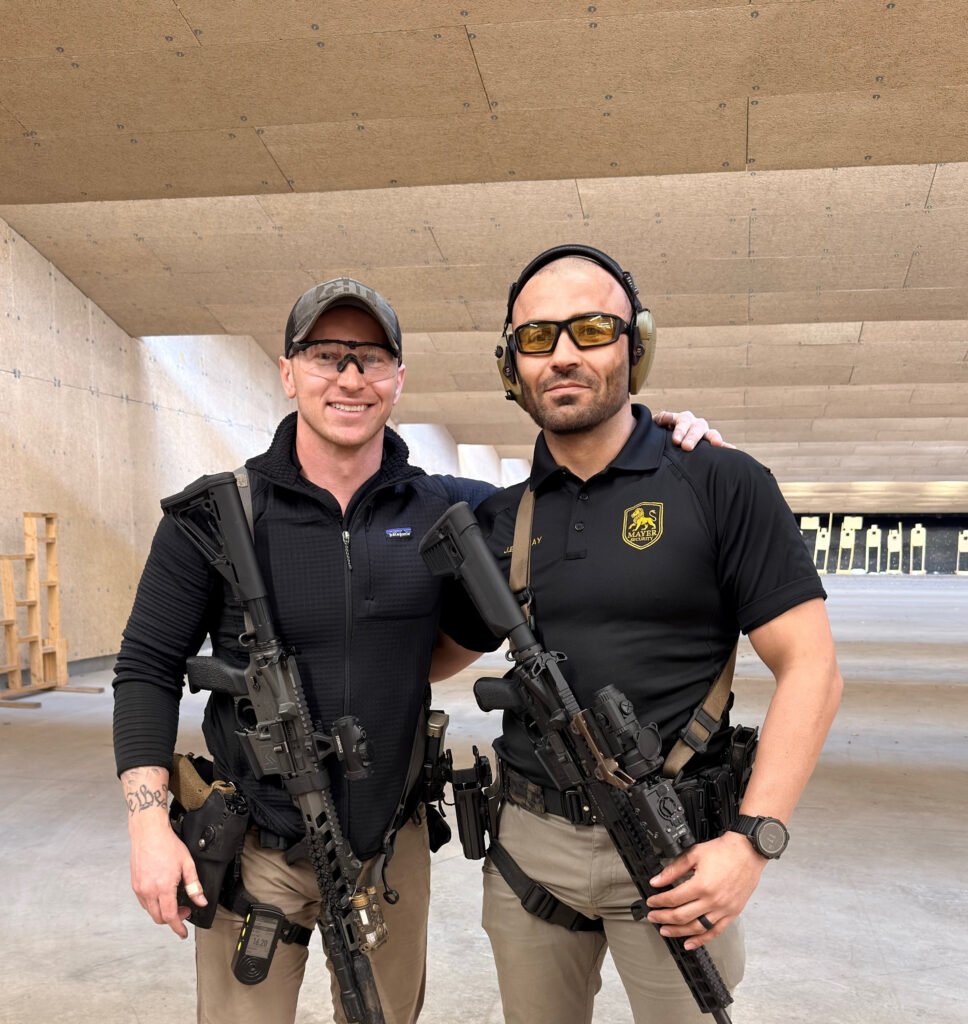
At Mayer Security Service, this is the standard. Our operators don’t coast on minimum qualifications. They train their minds and their hands to operate ahead of the threat, not behind it. Because the people we protect deserve nothing less.
Follow our training content on the Mayer Security YouTube channel.
Train hard. Train honest. Perform on demand.
Mayer Security Service is a Houston-based security company delivering elite protection through continuous professional development and industry-leading training. Learn more about our services.